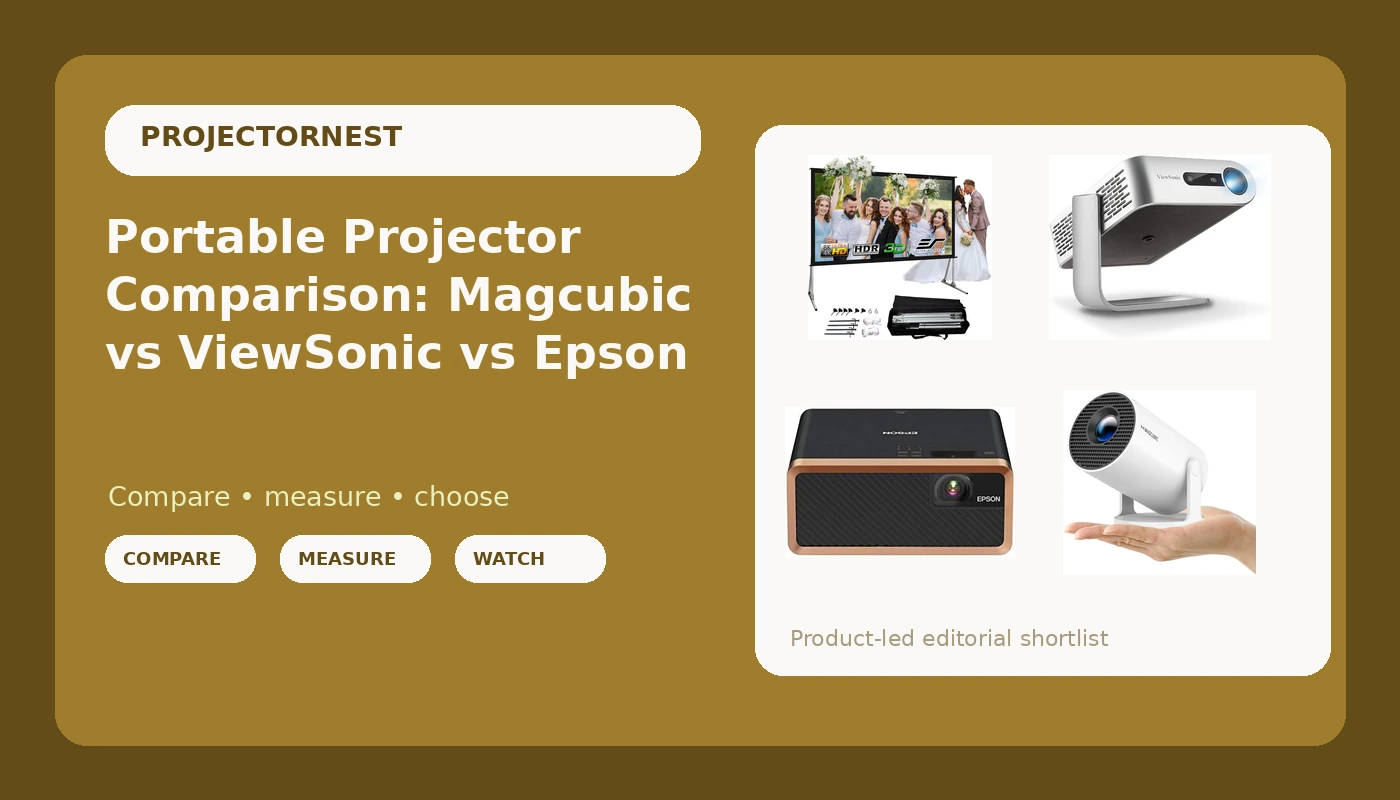
I have hung projectors in basements with zero windows and in living rooms where the sun wins every argument. I live in Raleigh, I have been doing this for fifteen years, and most of the money I have watched people waste went to a projector that was too dim for the room it landed in. So when I build a portable projector comparison, I start with the room, not the spec sheet. The room is the thing you cannot return.
This one covers four different purchases: the Magcubic HY300PRO mini, the ViewSonic M1+ portable LED, the Epson EF-100 laser, and the Elite Screens Yard Master 2, which is not a projector at all. It is the 120-inch outdoor screen that makes the other three worth owning. That last part matters more than people expect. Half the backyard movie nights I get called about fail because someone bought a projector and pointed it at a beige fence in a yard with a porch light on.
Related: Backyard Movie Night Setup Guide
The short version: the Epson EF-100 is the one I would put in a living room, the ViewSonic M1+ is the one I would carry from room to room, the Elite Screens Yard Master 2 is the purchase that makes outdoor viewing work at all, and the Magcubic HY300PRO is the cheapest way to find out whether your household will actually sit through a projected movie.
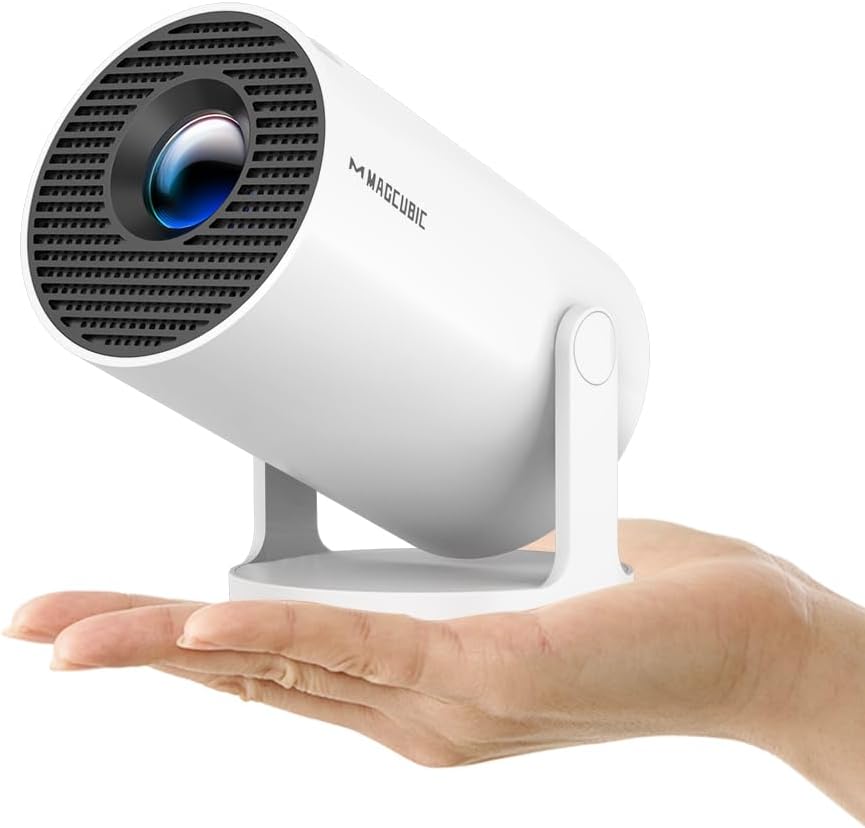
Magcubic 2026 Upgraded HY300PRO Mini Projector with WiFi and Bluetooth, Portable Projector 4K Support, Auto Keystone, 180 Degree Rotation, Smart Proyector for Home Outdoor
Lowest cost of entry here, WiFi and Bluetooth built in, auto keystone, and a rotating body that can throw onto a wall or a ceiling without a stand
A mini projector in this class is a dark-room toy, "4K support" describes the signal it accepts, and there is no lamp, LED, or laser spec spelled out to judge it by
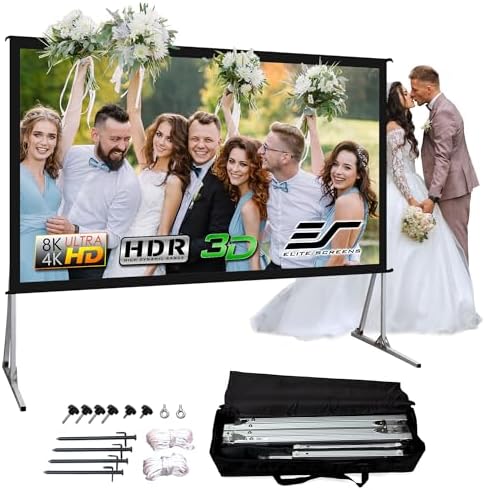
Elite Screens Yard Master 2, 120-inch Outdoor Portable Fast Folding Projector Screen w/ Stand 16:9, 8K 4K Ultra HD 3D Movie Theater Cinema REAR Projection, OMS120HR3, US Based Company 2-YEAR WARRANTY
A real 16:9 surface with its own stand, rear projection capable, fast folding, and a two year warranty from a US based company
It is a screen and not a projector, so it doubles the budget, and it is a large object to store between movie nights
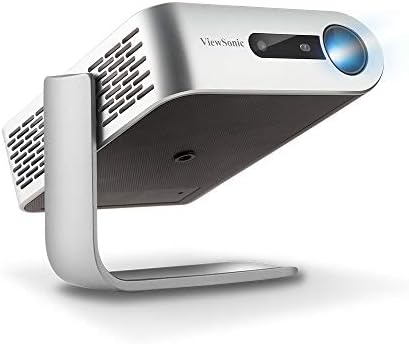
ViewSonic M1+ Portable LED Projector with Auto Keystone, Dual Harman Kardon Bluetooth Speakers and HDMI, USB C, Stream Netflix with Dongle (M1PLUS)
Harman Kardon speakers are built in, so you do not need a soundbar on day one, and HDMI plus USB C covers laptops, consoles, and phones
LED portables trade brightness for lifespan, and streaming apps mean buying and packing a dongle
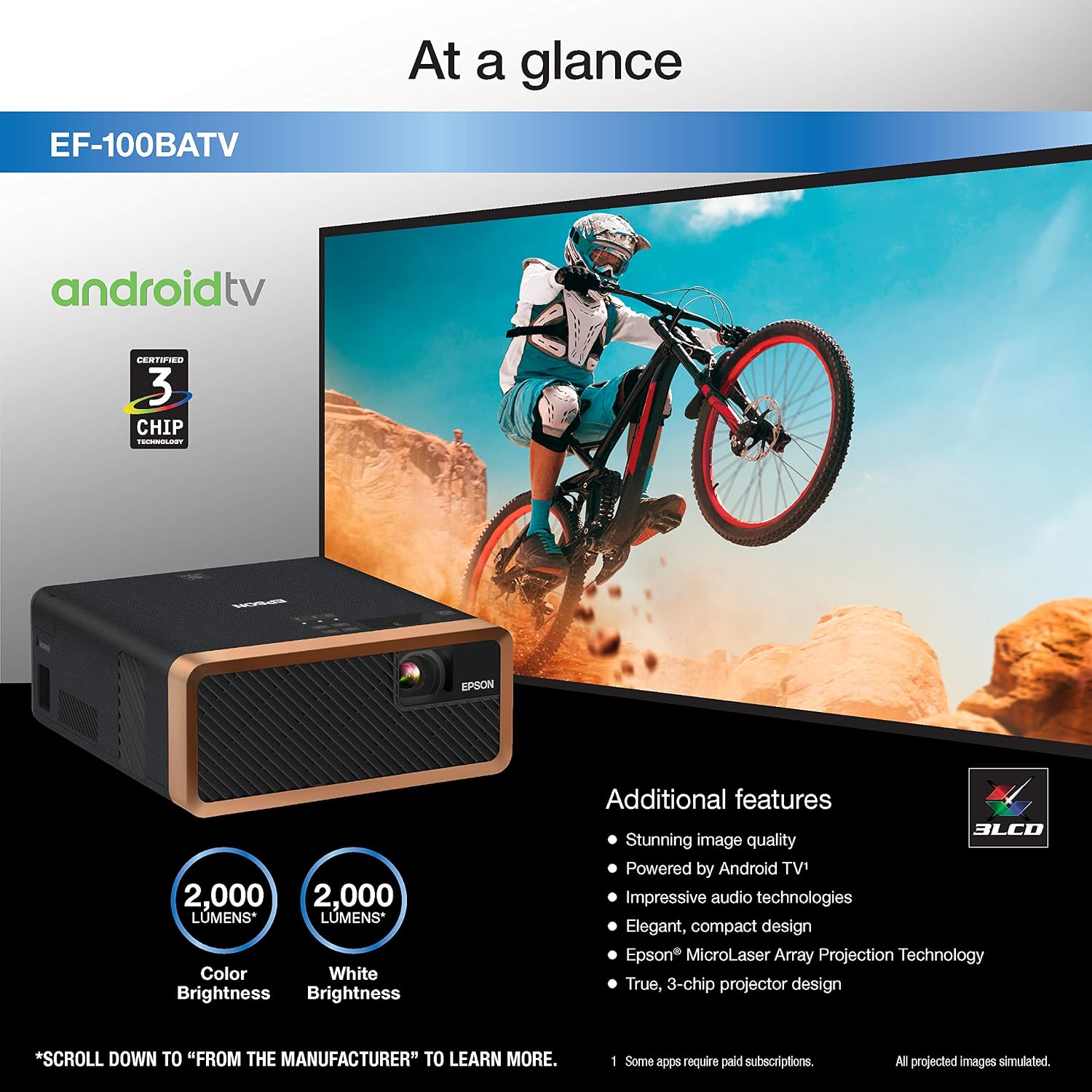
Epson EF-100 Smart Streaming Laser Projector with Android TV - Black
A laser light source with no lamp to replace, Android TV built in so streaming does not depend on a dongle, and Epson's support behind it
Highest cost in the group, Android TV gets old faster than the light engine does, and nothing in the listing promises a battery
Prices and availability were captured from Amazon Creators API and may change.
How I judge a projector listing
I do not grade these four by the photos on the box. I grade them by four questions, in this order. What is the real light output? Does the lens give me any room to work, meaning zoom or shift, or am I moving furniture to change the image size? How loud is the fan going to be at full power, because a projector that sounds like a hair dryer ruins a quiet scene? And would I sit through a whole movie with it in my own room?
That last question is the one that kills most impulse buys. A projector that looks amazing in a fifteen second demo clip can still be unwatchable for two hours, and it is almost always brightness or fan noise that does it, not resolution.
I keep a colorimeter on the bench, and I do use it. But a listing is not a lab result, and I am not going to pretend otherwise. Where a number would settle a question, I will tell you which number to go find before you spend anything. That is more honest than a table of values I did not measure.
Reading the claims in these listings
Three words in these names deserve translation.
ANSI lumens is the brightness figure the industry actually measures. If a listing gives you a big bright number and never says ANSI, treat it as marketing and assume the worst case, because that is what you will be living with.
"4K support" means the input chain accepts a 4K signal. It does not mean the projector puts 4,000 pixels across your wall. On a mini projector at this price, always check the native resolution before you assume anything. Pixel shifting on a decent 1080p chip looks great and I will defend it, but that is a different claim than what a sticker implies.
Light source is the third one. Lamp projectors need bulb replacements, LED light engines run long and cool but are usually dim, and laser sits at the top for lifespan and consistency. In this group you have LED, laser, and one listing that does not tell you outright, which tells you something on its own.
And the one spec nobody prints: contrast ratio. Ignore it. Every number is fiction until you see the projector in your own room.
The budget entry: Magcubic HY300PRO
The HY300PRO is the cheapest way into this hobby I have seen in a while, and I mean that as a real compliment. WiFi and Bluetooth are built in, so it can pull a stream and push sound without a pile of adapters. Auto keystone means you can set it on a coffee table and get a rectangle back without a ladder. The 180 degree rotation is the feature I like most: a body that turns that far can throw onto a wall, a ceiling, or the side of a tent from whatever surface you already have.
The honest limits are the same limits every mini projector has. This is a dark-room device. Put it in a bright living room at 3 p.m. and you will be watching a fog, which is the failure mode I complain about most. Nothing in the listing tells you the light source or an ANSI figure, so the brightness claim is a question mark, not a promise.
Buy it if the family has never owned a projector and you want a low-risk experiment. Do not buy it as the centerpiece of a room you actually use with the lights on.
The carry-it-anywhere pick: ViewSonic M1+
The M1+ solves the problem that sinks most casual setups: sound. Dual Harman Kardon speakers are built in, so there is no soundbar to buy, no cable to run, and no excuse for tinny audio coming out of a laptop. Auto keystone keeps setup quick, and HDMI plus USB C covers a laptop, a console, or a phone without a drawer full of dongles.
The light engine is LED, which is the right call for a portable. LED runs cool and has no bulb to replace, and in exchange it gives up brightness. That trade is the entire personality of this projector. It is a dark-room and evening-porch device that happens to fit in a bag.
The catch is in the name: "Stream Netflix with Dongle." That dongle is an extra purchase and an extra thing to remember, and if you forget it at home your streaming apps do not exist. I have watched people discover that at 8 p.m. in a backyard. If you want streaming without a dongle, that is what the next pick is for.
The laser pick: Epson EF-100
The EF-100 is the only projector here I would describe as an actual living room device rather than a toy that lives in a closet. Laser is the reason. There is no lamp to count hours on, no bulb to order in three years, and laser output holds up better over the life of the unit. That is worth real money over a ten year horizon, and I say that as someone who has replaced plenty of bulbs.
Android TV is built in, so streaming does not hinge on a dongle you left on a desk. You sign in, you browse, you watch. The chassis is black and unobtrusive, which matters if this is going on a shelf instead of a theater ceiling.
Two things to accept before you pay. First, laser does not beat physics: if your room has windows and no shades, no projector at this tier wins, and you should spend on blackout curtains before you spend on the projector. Second, nothing in the listing promises a battery, so plan on an outlet and a cable. This is the one that stays put, and it is the best of the four for that job.
The purchase everyone forgets: Elite Screens Yard Master 2
Half of the backyard movie setups I get asked to fix have a screen problem, not a projector problem. A painted wall, a beige fence, or a bedsheet eats brightness and color and then blames the projector. The Yard Master 2 is a real 16:9 surface with its own stand, at 120 inches diagonal, and that number is the point: this is a genuinely large image, which is the entire reason to watch outside instead of on the TV.
Two features earn their mention. Rear projection capability means you can put the projector behind the screen and keep the light out of the audience's eyes, which is how actual outdoor cinema setups are built. And it folds fast, which decides whether you use it twice a year or every weekend in September. The 2-year warranty from a US based company is a reasonable backstop for something that lives outdoors part time.
The trade-off is obvious. It is a screen, so it does not project anything, and it doubles what you have to spend. It is also bulky when packed. If you want a permanent outdoor setup, this is the right foundation. If you want something that disappears into a closet shelf, measure the storage space first.
Where each one loses
The Magcubic loses to ambient light and to a listing that keeps its light source to itself. Cheap is not the same as competent, and a dark-room mini projector is not a living room projector.
The ViewSonic loses to brightness and to that dongle. Great sound, great portability, and a ceiling on how big and how bright the image can get.
The Epson loses on price and on software lifespan. Android TV is convenient now and will feel dated before the laser wears out. That is a fair trade for most people, and it is still a trade.
The Elite Screens loses on portability and on being a second purchase. It does not make a bad projector good. It stops a good projector from being wasted, which is a different and more useful job.
Which one for which room
A dedicated dark room with a fixed projector position: the Epson EF-100, every time. Laser, built-in streaming, no bulb to change. Pair it with the Yard Master 2 only if the room is outdoors or you want a screen you can move.
An apartment, a dorm, or a bedroom where the projector lives in a bag: the ViewSonic M1+ is the one I would hand someone, mostly for the built-in speakers. If you already own a Bluetooth speaker you like, the Magcubic HY300PRO does the same basic job for a lot less and you can put the savings toward a screen.
A first projector for a family that has never had one: the Magcubic HY300PRO. Not because it is the best, but because it answers the real question, which is whether anyone in the house will actually sit through a movie this way. If the answer is yes, you will know exactly what you want to upgrade to.
Backyard movie nights, lights off, guests on chairs: the Elite Screens Yard Master 2 plus whichever projector you own. The screen is the upgrade most people skip.
What to check before you click buy
Get the ANSI lumen figure, or accept that you are guessing. Confirm the native resolution, not the "support" language. Measure the distance from your seating to your wall and check the throw ratio, because a short room needs a short throw projector and no amount of return shipping makes that fun. Check whether streaming is built in or needs a dongle. Decide where the thing lives when it is not in use, since that answer eliminates more candidates than specs do.
Then set a budget for the screen, blackout curtains, or both. A $5,000 projector in a bright room loses to a modest projector in a dark one. Room control wins, and it always has.